The First Five Feet
What California's New Zone 0 Rules Actually Mean for Your Fence, Gate, Deck, and Patio Cover
By Tyler Julka | T.J. Julka Construction, Inc. | CSLB #1104821, Class B General Building Contractor
Original post date: August 29, 2026
Last updated: September 5, 2026
I posted some photos of the last few years of work in a couple of local groups last week, and the comments turned into something else entirely. People were worried. One neighbor said homeowners will have to tear out every wooden structure attached to their house within five years. Another asked what they're supposed to do about the deck that's already there. Someone else wanted to know whether any of this touches decks at all, or just fences and gates.
So I spent a few days reading the actual rules instead of the posts about the rules. This is what I found.
I build fences, gates, decks, arbors, pergolas, and patio covers out of Con Heart redwood in Sunland, Tujunga, La Crescenta, Shadow Hills, and Altadena. Most of my service area sits in a Very High Fire Hazard Severity Zone. I have a direct financial interest in you understanding these rules correctly — in both directions. If I told you the rules were harmless, you'd hire me for work that gets red-tagged. If I told you the sky was falling, I could sell you a tear-out you don't need. Neither of those is a business I want.
Here's the honest version.
Part 1: What Actually Happened on August 19
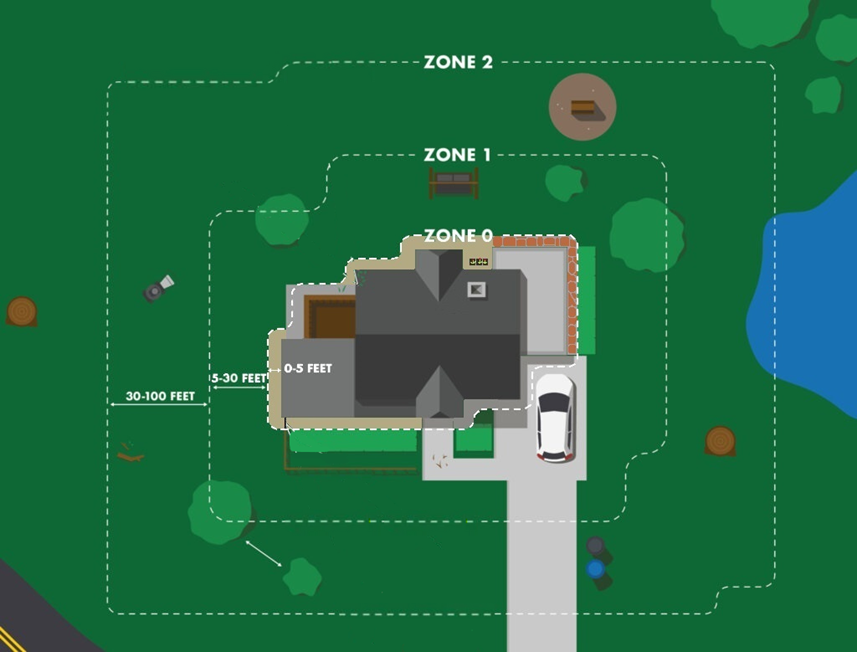
Defensible space zones 0, 1, and 2.
Credit: California Board of Forestry and Fire Protection
The California Board of Forestry and Fire Protection voted unanimously — 8 to 0 — to approve the final draft of the Zone 0 defensible space regulations. This is the first statewide rule in the country governing the five feet immediately around a home.
It is not law yet. The approved package goes to the Office of Administrative Law for legal review, which includes a short public comment window. Board officials indicated that review would wrap in early September 2026. The rule becomes enforceable once it's approved and filed with the Secretary of State — expect roughly the end of September or October 2026.
The content is settled. The date isn't, quite. Anyone giving you a hard compliance deadline right now is guessing at the last few weeks.
Where it came from: Assembly Bill 3074 (2020) directed the Board to create an ember-resistant zone. Senate Bill 504 (2024) and Assembly Bill 1455 (2025) adjusted the mandate. Governor Newsom's Executive Order N-18-25, signed after the January 2025 Eaton and Palisades fires, ordered the Board to finish the job. It took about fifteen months of workshops, site visits, and some genuinely loud public fights to land here.
Why it exists: Post-fire investigations keep finding the same pattern. Homes are lost overwhelmingly to wind-blown embers, not to a wall of flame arriving. Embers land, collect in corners and against foundations, and find something to burn. The first five feet is where that happens.
Part 2: The Three Rulebooks People Are Mixing Together
Almost every wrong thing I read in those comment threads came from mashing three separate bodies of law into one. They have different triggers, different timelines, and different enforcement. Untangling them fixes most of the confusion.
Rulebook 1 — Defensible Space (Public Resources Code 4291, Title 14)
What it governs: What you keep on your property. Vegetation, mulch, firewood, stored items, and now the first five feet.
Who it applies to: Everyone in the covered zones, right now, regardless of when your house was built. This is maintenance law, not construction law.
Who enforces it: CAL FIRE and your local fire department. In my area, LAFD and LA County Fire.
This is where Zone 0, Zone 1, and Zone 2 live. The new rules are an addition to this rulebook.
Rulebook 2 — Chapter 7A / Title 24 (The Building Code)
What it governs: How things are built. Materials, assemblies, roof coverings, vents, eaves, siding, deck walking surfaces.
Who it applies to: New buildings permitted on or after July 1, 2008, in a Fire Hazard Severity Zone or designated Wildland Interface Fire Area. Plus additions and remodels, with an exception for work on buildings originally constructed before July 1, 2008.
Who enforces it: Your building department, at plan check and inspection.
Critical point: Chapter 7A is not retroactive. Nobody is coming to your 1958 ranch house to inspect your siding. It attaches when you pull a permit.
The current cycle is the 2025 California Building Standards Code, effective for permit applications submitted on or after January 1, 2026. There is no grandfathering based on when you planned or contracted the work — only on the submittal date.
Rulebook 3 — Local Ordinances
Cities and counties can go stricter than the state. They can also propose alternative approaches, as long as those achieve equivalent fire safety outcomes and get approved by the local governing body in coordination with the fire agency.
For my neighbors in the City of Los Angeles, this matters immediately: LAFD's brush clearance requirement extends 200 feet, not the state's 100. That's already the rule, and has been.
The LA City Council has directed work on a local Zone 0 ordinance, driven by concerns about hillside compliance costs and urban tree canopy. My read: don't plan around it. The state rules set a floor, and a meaningfully weaker local version is unlikely to survive preemption. Build to the state standard and you're safe either way.
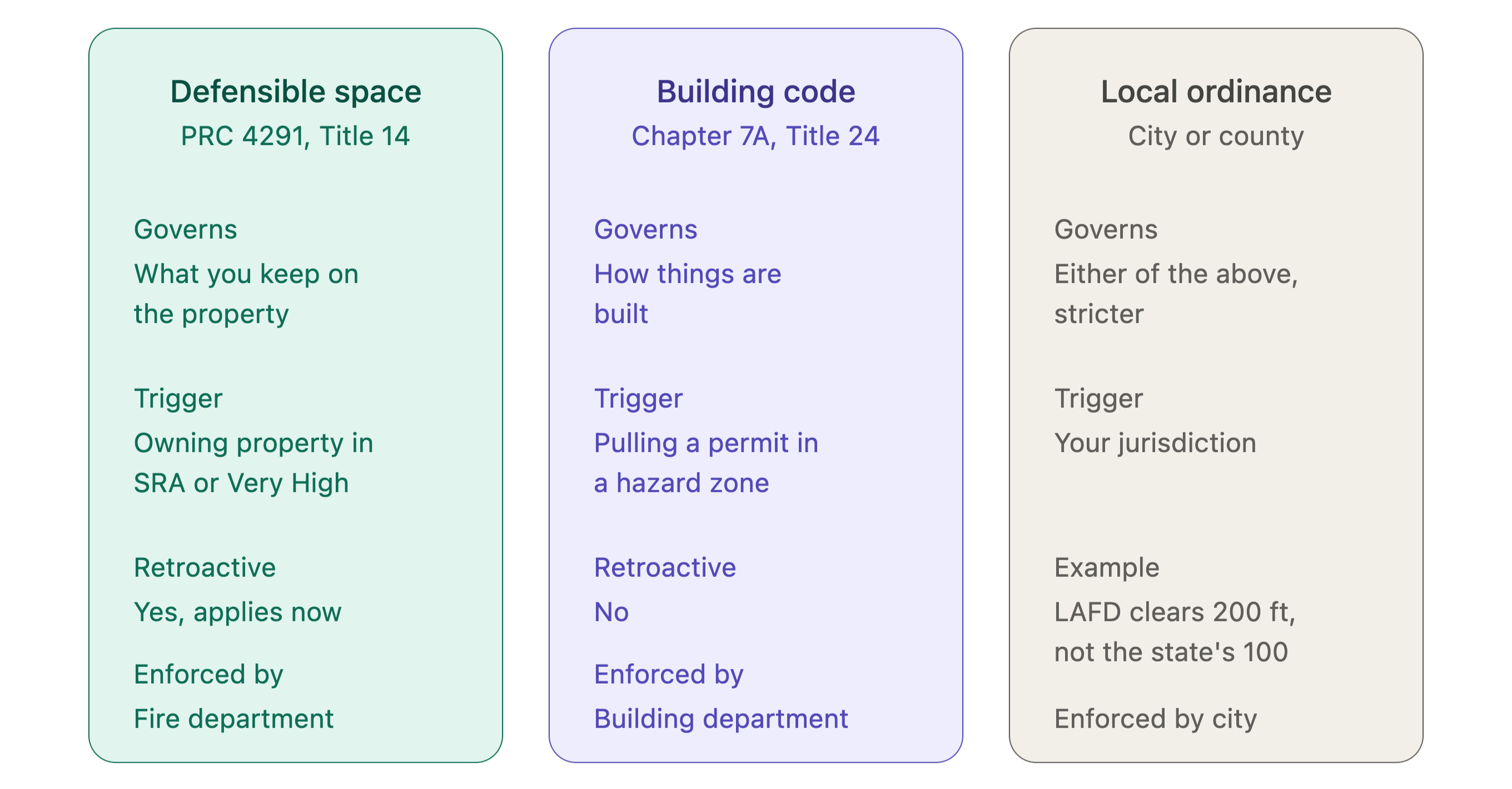
Distinctions between the different groups of rules will be super important to pay attention to.
Part 3: Does Any of This Apply to Your House?
Zone 0 applies to two categories:
All properties in a State Responsibility Area (SRA) — the areas where CAL FIRE has fire protection responsibility.
Properties mapped Very High Fire Hazard Severity Zone (VHFHSZ) inside city and county jurisdictions (Local Responsibility Area).
Note what's not in there: if you're inside a city and your parcel is mapped High or Moderate rather than Very High, the state Zone 0 rule does not reach you unless your local jurisdiction extends it.
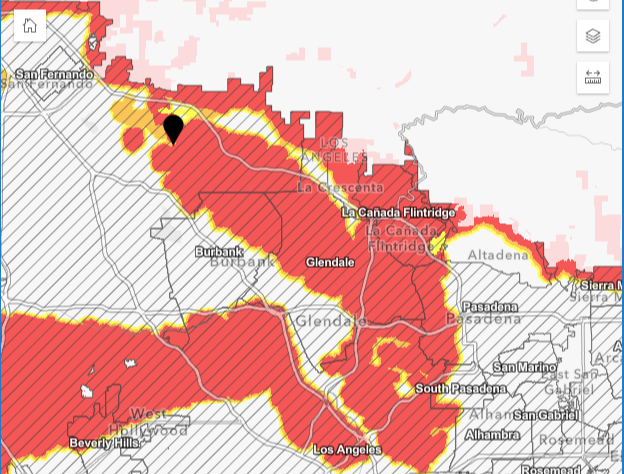
Screenshot of local fire hazard areas from OSFM viewer.
Check your own address. Don't take a neighbor's word for it, and don't assume based on the street. Search for the CAL FIRE Office of the State Fire Marshal Fire Hazard Severity Zone viewer and look up your parcel. Zone lines run through neighborhoods, not around them.
Most of the Altadena, Pasadena, La Cañada, Sierra Madre, Sunland-Tujunga, and Shadow Hills foothill belt is mapped Very High. If you're reading this because you saw my post in a local group, you should assume you're in until you confirm otherwise.
Part 4: What Zone 0 Actually Requires
The early drafts genuinely did read like a ban on landscaping. The approved version is narrower and more thought-through. It splits the five feet into two nested areas.
The Safety Zone (vegetation-free)
Immediately against the house, a strip that must be free of vegetation:
A minimum of 1 foot from the structure, or out to the drip line of your eaves — whichever is greater. One-foot eaves means a one-foot strip. Two-and-a-half-foot eaves means a two-and-a-half-foot strip. Shallow or no eaves still means at least one foot.
2 feet from windows, glass doors, and vents.
5 feet around attached decks and similar deck-like features.
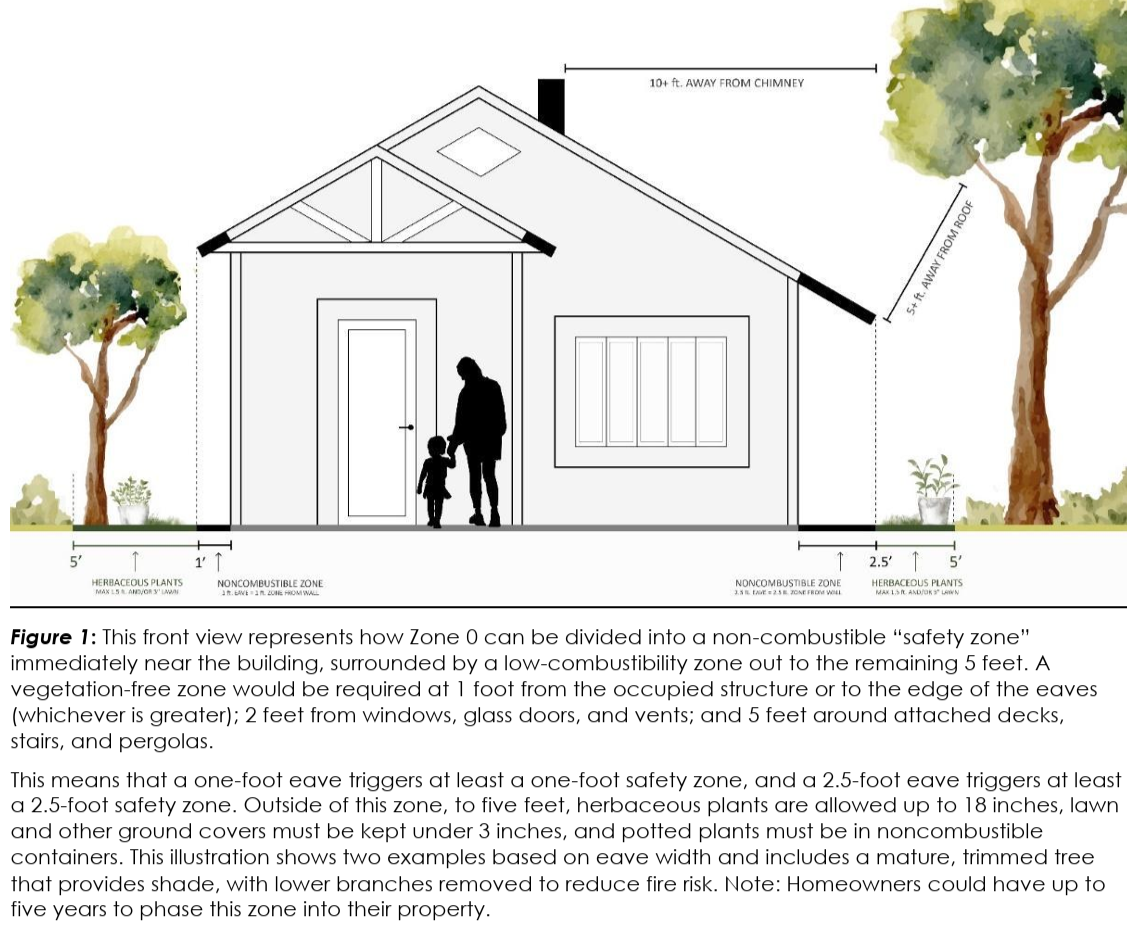
Credit: Board of Forestry and Fire Protection Draft Zone 0 Regulations / April 2026
The Low-Combustibility Zone (out to 5 feet)
Beyond the safety zone, out to the five-foot line, plants are allowed within limits:
Herbaceous (non-woody) plants up to 18 inches, in spaced groupings — bulbs, poppies, petunias, succulents.
Low ground covers under 3 inches — moss, creeping thyme, beach strawberry.
Lawn, maintained per the requirements.
Potted plants in easily movable, noncombustible containers.
Not Allowed Anywhere in Zone 0
Bark mulch, wood chips, gorilla hair, combustible mulch of any kind
Dead leaves, needles, and debris — including on the roof and in the gutters
Firewood and stored lumber
Dead and dying vegetation
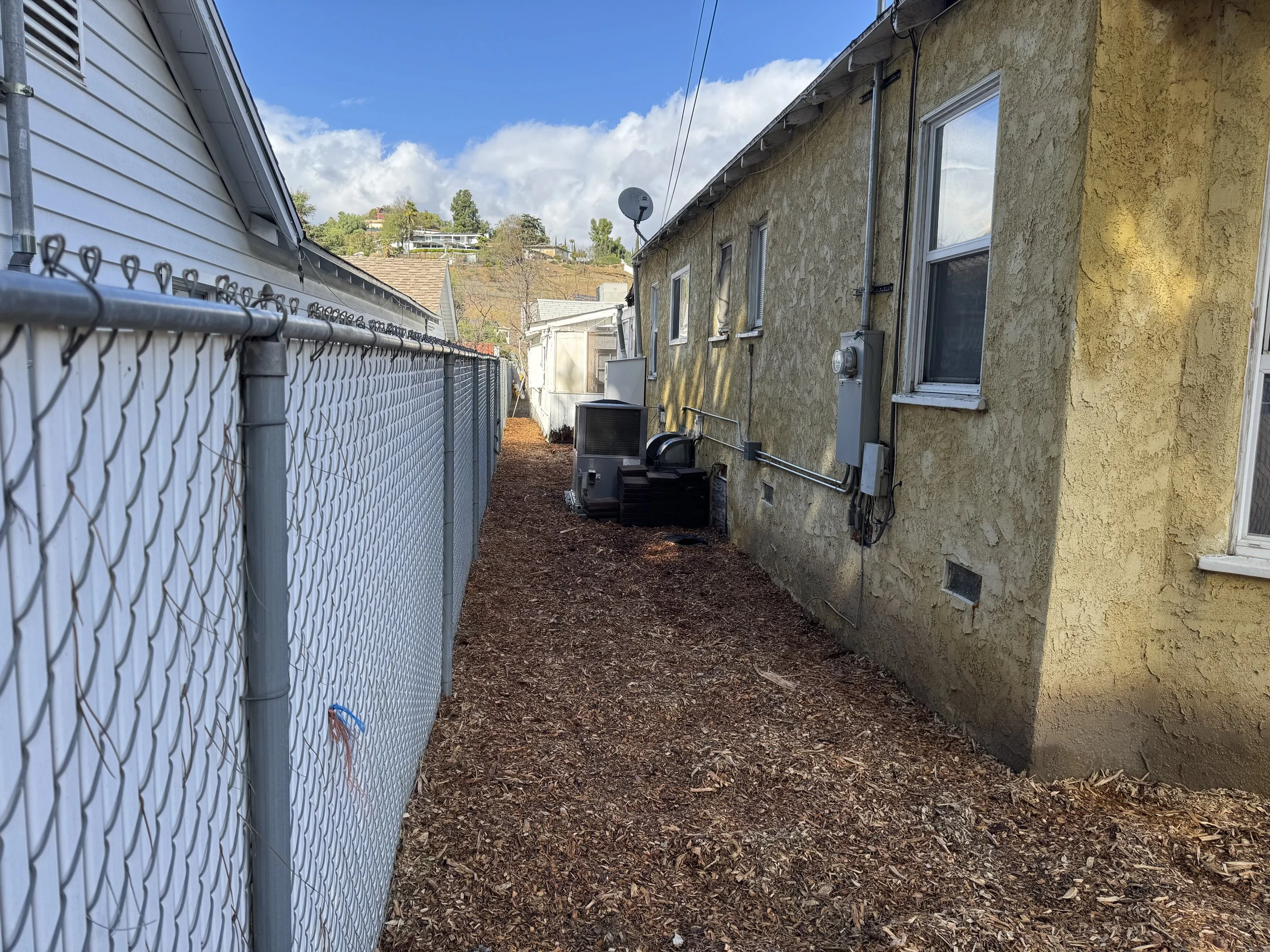
Bark mulch placed directly against home foundation in Shadow Hills.
Trees
Trees are allowed. This was the single loudest fight in the whole process, and the Board landed on maintenance rather than removal:
Branches at least 10 feet from chimneys and stovepipes
Branches trimmed 5 feet above the roof
Branches trimmed out from under eaves
Dead wood and ladder fuels removed — bottom 6 feet on large trees, lower third on smaller trees
Your mature shade tree does not have to come out. It has to be pruned.
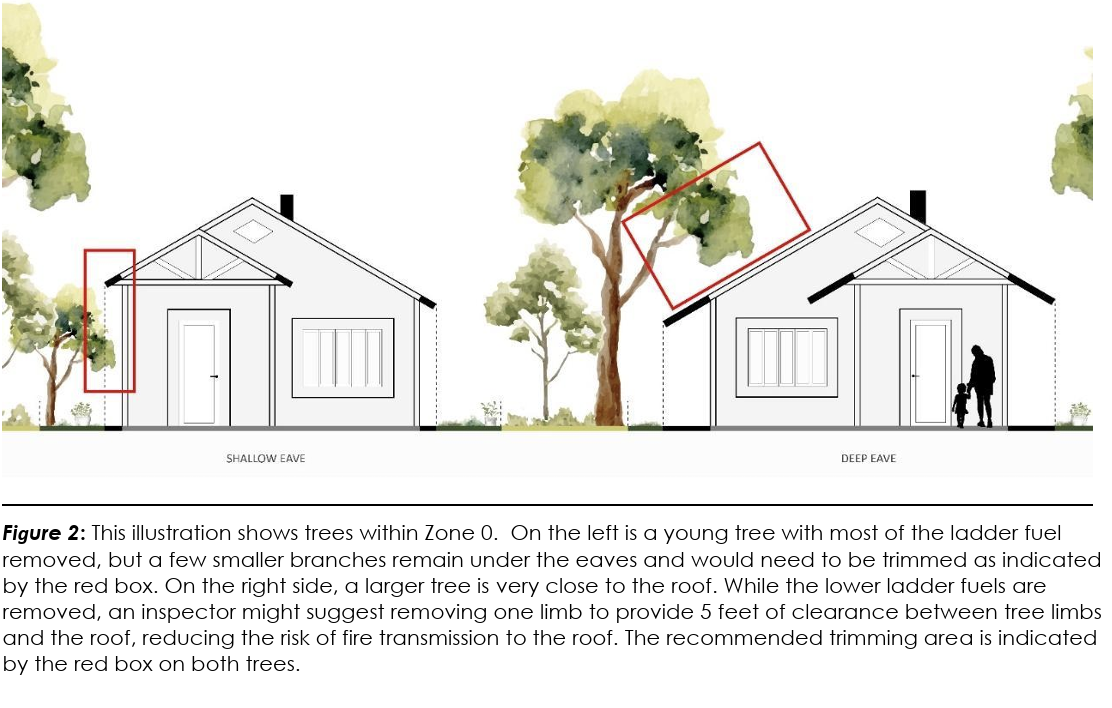
Credit: Board of Forestry and Fire Protection Draft Zone 0 Regulations / April 2026
Part 5: The Timeline (This Is Where the Panic Came From)
New construction and rebuilds — day one
If your permit application goes in after the rule takes effect, you comply with everything immediately. No phase-in.
This is the whole ballgame for the Eaton Fire rebuilds still in permitting in Altadena. If you're designing a rebuild right now, the first five feet is a design decision, not a future chore. Getting it wrong means redoing landscaping and fencing after you've already paid for it once.
Existing homes — Phase 1, within 3 years
The housekeeping tier:
Remove combustible items from the first five feet — firewood, mulch, wood chips, dead leaves and branches
Clean roofs and gutters
Remove dead and dying plants
Trim trees to the standards above
Implement or adjust plantings to the allowable list
Existing homes — Phase 2, within 5 years
Local jurisdictions assign the specific timeline inside that five-year window. This tier covers the built items:
The under-eave / vegetation-free safety zone
Replacing combustible gates
Necessary adjustments to sheds and fencing
And a note on enforcement
The Board has been explicit that early implementation prioritizes education and outreach over penalties. Inspectors are looking for measurable progress. That is not the same as "nothing happens" — defensible space enforcement mechanisms already exist, insurers already evaluate the first five feet at renewal, and AB 38 requires documented compliance when you sell. But nobody is issuing citations in month two.
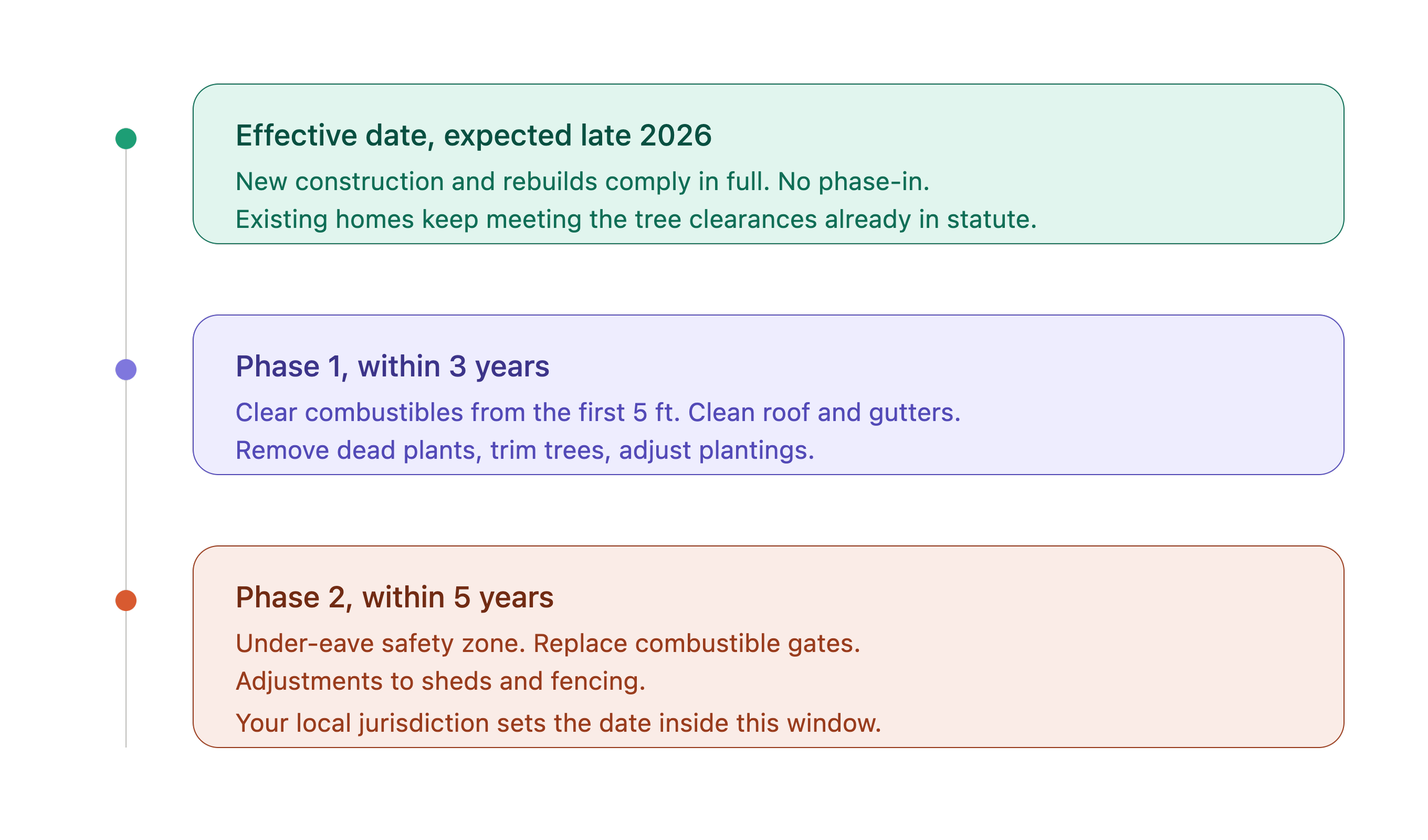
Implementation and enforcement timeline.
Part 6: Attached Structures, Specifically
This is the section people were actually asking about. I'm going to take these one at a time.
Fences
Here is the rule in full, because it's the most misrepresented one:
A five-foot noncombustible section is required where a fence attaches to the home. This is a Phase 2 item — up to five years, on your local jurisdiction's timeline.
No new combustible fence sections may be built within five feet of the structure after the effective date, including within five feet of an attached deck.
Repairs to existing combustible fences are still allowed.
Read that third line again. Repairs are allowed. Your wood fence is not contraband.
What this means practically: a wood fence that runs from your house out to the property line needs its first five feet converted to noncombustible material — masonry, steel, or another approved material — with the wood picking up beyond that transition. That's a five-foot section, not a fence.
I want to be direct about something. This transition is a design problem, and most of what I've seen so far is ugly. A hard butt joint between a steel panel and a redwood fence looks like a compliance patch, because it is one. It doesn't have to. A masonry pilaster, a steel post-and-panel bay detailed to match the fence rhythm, a stepped stone base — these read as intentional. If you're going to spend the money once, spend it on something you like looking at.
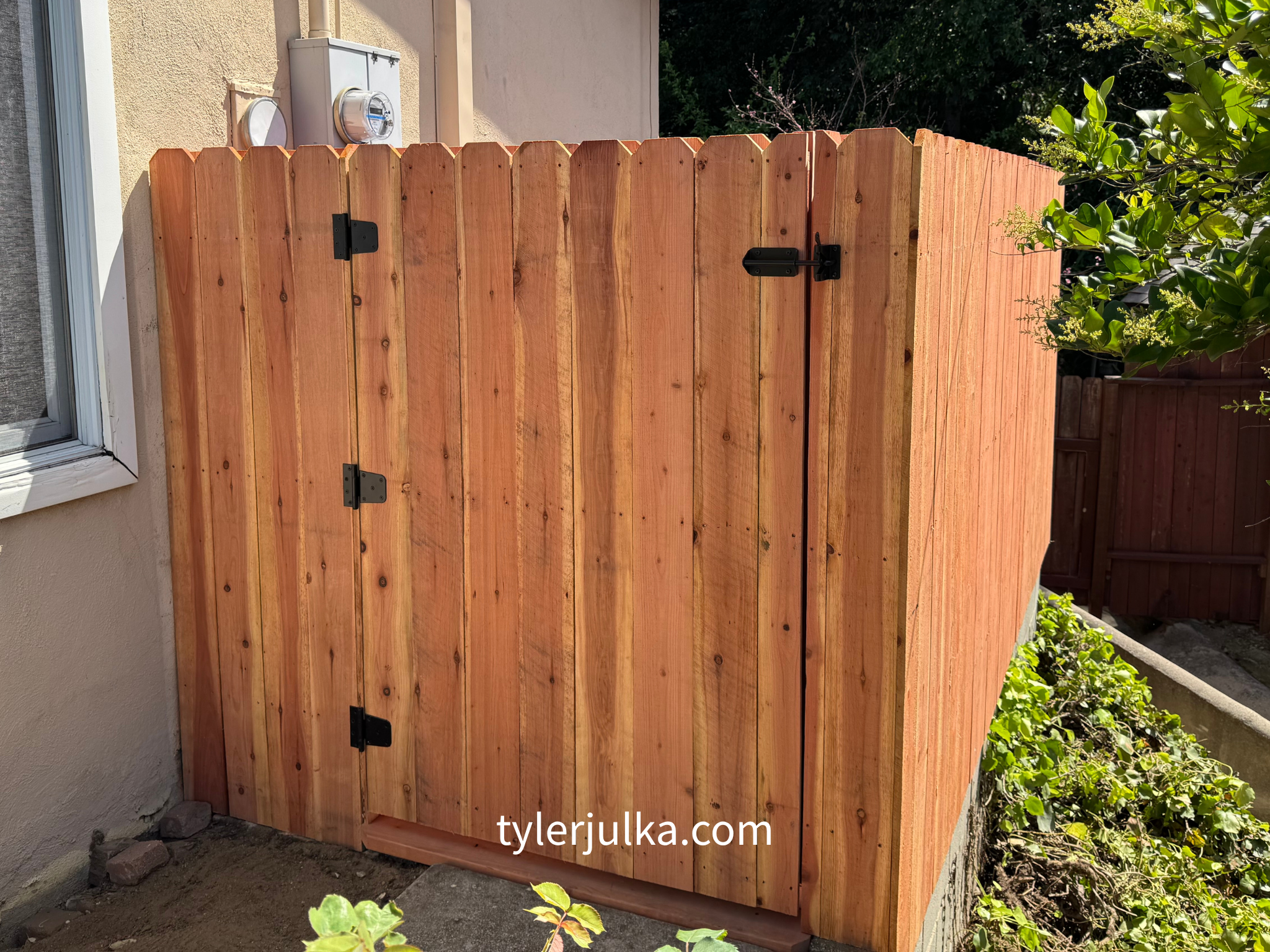
Redwood fence and gate attached to home in Glendale.
Gates
Combustible gates directly attached to the structure are out. The example the Board itself gives is replacing a combustible gate with a noncombustible metal gate. Also Phase 2.
A side note worth understanding: a gate is the piece of your fence that gets touched every day, swings on hardware, and takes weather from both faces. It's also the piece most likely to be within five feet of the house, because that's where the side yard entry is. If you're already thinking about a new gate for reasons that have nothing to do with fire, the timing is now favorable.
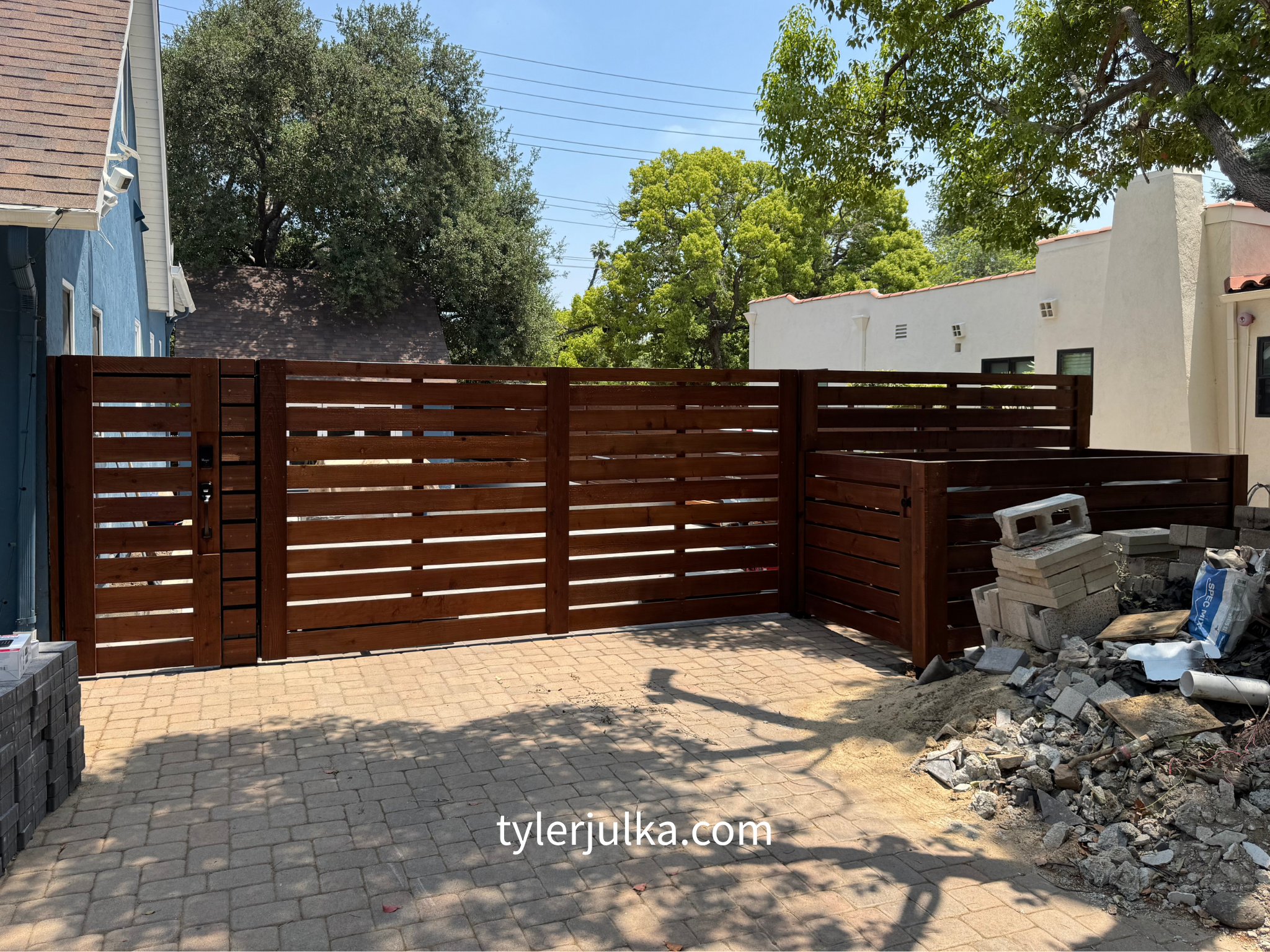
Redwood with steel frame - pedestrian gate and driveway gates attached directly to house, South Pasadena.
Decks — read this part carefully
Nothing in the Zone 0 rule requires you to tear out an existing attached wood deck.
The reason is a definition. Under the rule, a "Building or Structure" includes an attached deck. Your deck is treated as part of the house. That means Zone 0 is measured five feet out from the edge of the deck, not from the wall of the house.
So the deck isn't the thing being regulated. The deck is the thing Zone 0 is being measured from.
What the rule does require around decks:
No vegetation within five feet of an attached deck or similar deck-like feature.
The area under decks, balconies, and stairs must be kept free of vegetation and combustible items. This is also a Zone 1 requirement and has been for years. Clear out the stored lumber, the leaf pack, the pots, the bikes.
Where deck materials get regulated is Rulebook 2 — Chapter 7A, Section 709A — and that only triggers when you pull a permit for new construction or applicable work. Under 709A, the walking surface of decks, porches, balconies, and stairs within 10 feet of a building required to be WUI-compliant must be one of:
Noncombustible material
Exterior fire-retardant-treated wood (exterior-rated, labeled)
Heavy timber construction — sawn or glue-laminated with a smallest nominal dimension of 4 inches
Ignition-resistant material that passes the applicable State Fire Marshal test standards (SFM 12-7A-4, and 12-7A-5 where required)
Notice what item 3 means. Heavy timber is a compliance path. A deck framed and surfaced in genuine 4x material is not a workaround — it's one of the listed methods. That's a real design opportunity, and it's the direction I'd push almost any client who wants wood underfoot in a hazard zone.
And a warning on composite: "composite" is not automatically compliant. Compliance depends on the specific product being listed and tested. Check the CAL FIRE Building Materials Listing for the exact product and the exact use. I have watched people assume their way into a failed inspection on this one.
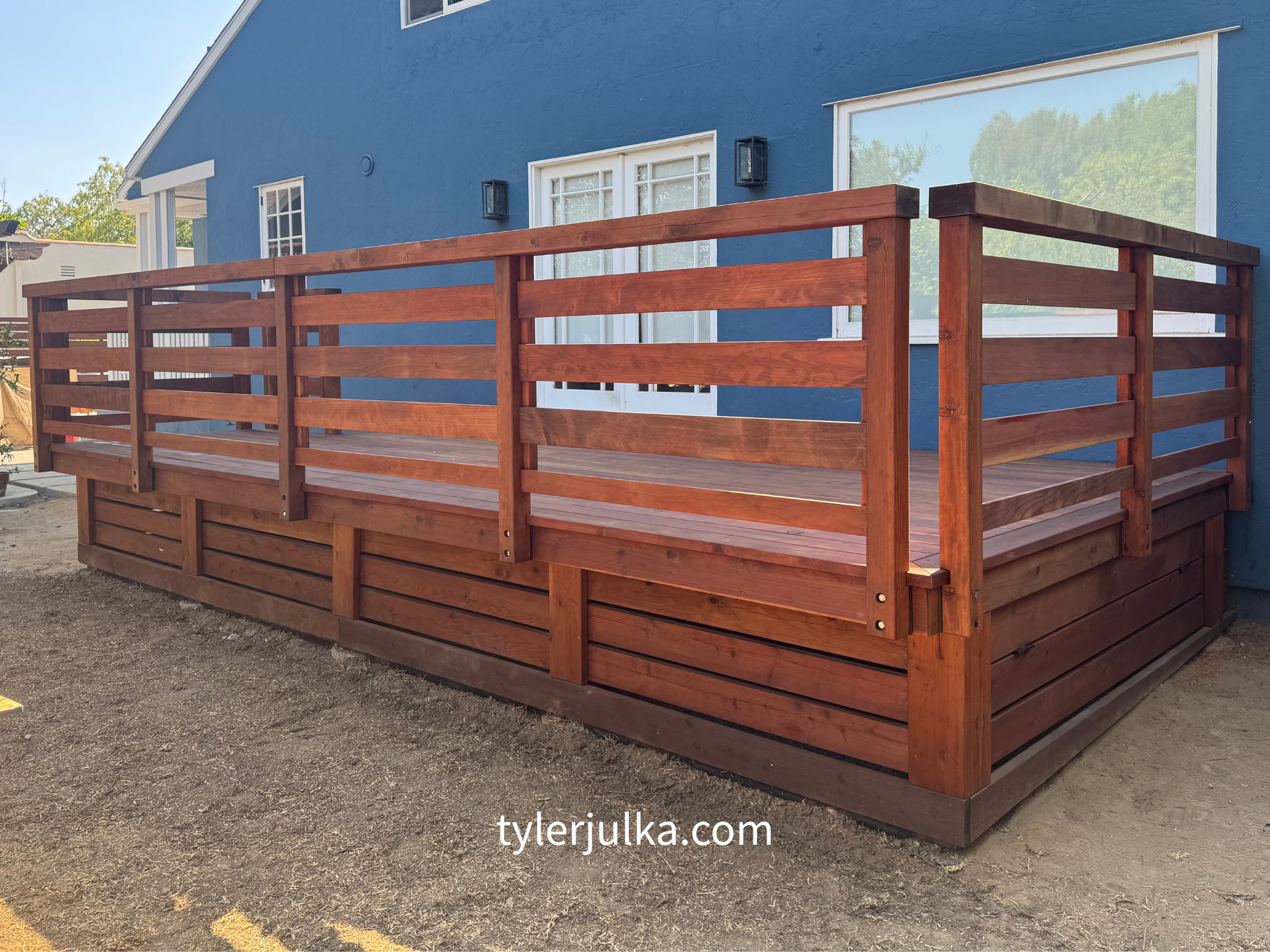
Freestanding redwood deck in South Pasadena.
Patio Covers, Pergolas, Arbors, Trellises, Gazebos
These fall under Chapter 7A, Section 710A, which explicitly covers attached and detached miscellaneous structures that require a building permit — trellises, arbors, patio covers, gazebos, and similar.
The trigger is a building permit. If your patio cover needs a permit — and attached ones generally do — 710A applies to the new work, and separation distance drives the requirements:
Less than 3 feet from an applicable building: the strictest tier
3 to 50 feet, for accessory buildings over 120 square feet: an intermediate tier
50 feet or more: no requirements under this section
Where ignition-resistant or noncombustible construction is required for an accessory building, its roof must also meet a Class A fire rating.
Again: not retroactive. Your existing pergola isn't affected by 710A. Your new one is.
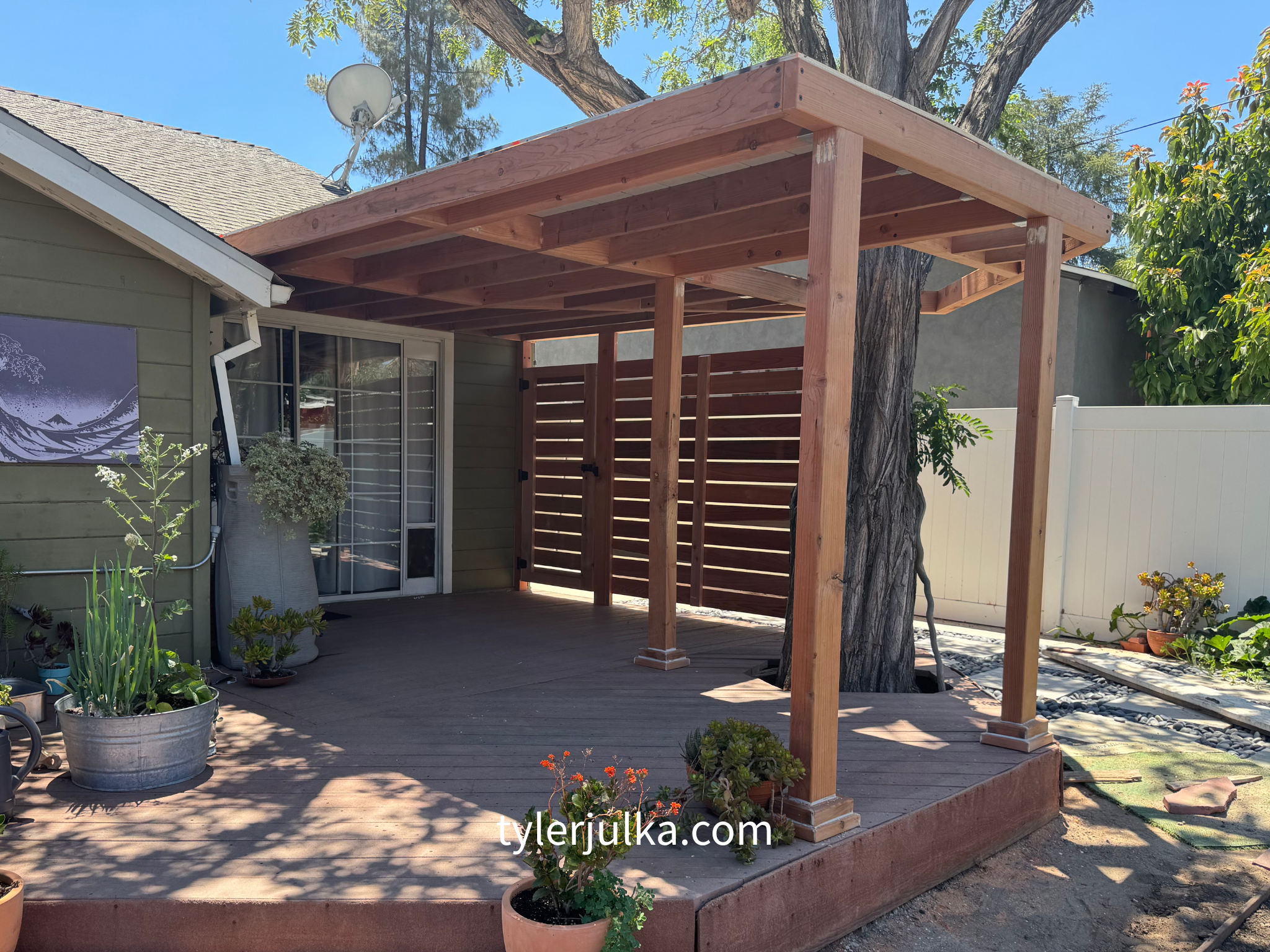
Attached redwood patio cover in Sunland.
Sheds and Outbuildings in Zone 0
The Board's summary states that sheds and outbuildings within Zone 0 must have noncombustible exterior roofs and walls. The rule text approaches it from the other direction: outbuildings aren't permitted in Zone 0 unless constructed to Chapter 7A standards — and one built to those standards is then treated as part of the structure for the purpose of measuring Zones 0, 1, and 2.
Either way, the practical answer: the wood garden shed tucked against the house is the single most exposed thing on most properties I walk. It's also the easiest thing to move. If it can go to Zone 2, move it. That's the cheapest compliance dollar you will ever spend.
Part 7: Fact vs. Myth
MYTH: "Homeowners will have to tear out wooden structures attached to their homes five years from now."
This is the comment that started all of this, and it's wrong in almost every particular.
The five-year figure is Phase 2, which covers three things: the under-eave safety zone, replacing combustible gates, and adjustments to sheds and fencing. Fence "adjustment" means a five-foot noncombustible section at the point of attachment — not the fence. Decks are not on the Phase 2 list. Patio covers and pergolas are not on the Phase 2 list. And none of it applies to homes outside the covered hazard zones.
MYTH: "Wood decks are banned in California."
No. Attached decks are defined as part of the structure. Zone 0 is measured from the deck's edge. Existing decks are not required to be removed or resurfaced. New permitted deck walking surfaces within 10 feet of a WUI-compliant building must meet 709A — and heavy timber and exterior fire-retardant-treated wood are both listed compliance paths.
MYTH: "You have to replace your whole wood fence with metal."
No. Five feet at the point of attachment. The rest of the run can stay wood, and repairs to existing combustible fencing remain permitted.
MYTH: "It applies to every home in California."
No. State Responsibility Areas and Very High Fire Hazard Severity Zones in Local Responsibility Areas. High and Moderate zones inside cities are not covered by the state rule.
MYTH: "This is already the law, effective immediately."
Not yet. Approved August 19, 2026; pending Office of Administrative Law review; expected effective around late September or October 2026.
MYTH: "Chapter 7A means my old house is out of compliance."
Chapter 7A is building code. It attaches to new construction and applicable permitted work — new buildings permitted on or after July 1, 2008, in the covered zones. It does not reach back and condemn existing construction.
MYTH: "Composite decking is automatically compliant."
No. It depends on the specific product's listing and test results. Verify against the CAL FIRE Building Materials Listing before you buy.
MYTH: "If I wait, LA will pass something more lenient and I'll be off the hook."
Local jurisdictions can go stricter, and can propose alternatives that achieve equivalent outcomes. A significantly weaker local rule runs into state preemption. Waiting is a bet against the floor holding, and the floor usually holds.
FACT: New construction and rebuilds comply from day one, with no phase-in.
FACT: Repairs to existing combustible fences remain allowed.
FACT: Trees are allowed in Zone 0, with maintenance.
FACT: Your insurer is already looking at your first five feet, regardless of what the regulation says. Carriers evaluate ember-resistant conditions at renewal, and the state's Safer from Wildfires framework already recognizes this work. AB 38 requires documented defensible space compliance at sale. The regulatory deadline is the last reason to do this.
FACT: The rule text is silent on artificial turf. Neither approved nor prohibited by name. Treatment will fall to inspector judgment under the general combustibility standard. Be skeptical of anyone selling you a definitive answer.
Part 8: "I Already Have a Wooden Structure Attached to My House. What Do I Do?"
The most common question I got, and it deserves a real answer rather than a sales pitch. Work through it in this order.
Step 1 — Confirm you're actually in scope. Look up your parcel on the OSFM Fire Hazard Severity Zone viewer. If you're not in an SRA or a VHFHSZ, the state Zone 0 rule doesn't reach you. Check your local ordinance anyway.
Step 2 — Identify what the structure is.
Attached deck → not a removal target. Clear underneath it, keep vegetation five feet back from its edge. Nothing further unless you permit new work.
Attached patio cover, pergola, arbor → not a Zone 0 removal target. Chapter 7A applies to new permitted work only.
Fence meeting the house → five-foot noncombustible section at the attachment, Phase 2 timeline.
Gate attached to the house → replacement with noncombustible, Phase 2 timeline.
Shed or outbuilding within five feet → either build to Chapter 7A standards or relocate it. Relocating is usually cheaper and always faster.
Step 3 — Do the free work first. Before you spend a dollar on materials, do the things that cost only a Saturday: clear the roof and gutters, pull the bark mulch away from the foundation, move the firewood pile to Zone 2, clean out under the deck and stairs, cut the dead branches, check chimney clearance. This is most of Phase 1, it's required on day one anyway, and it's the first thing any inspector looks at.
Step 4 — Sequence the built items on your own schedule. You have three to five years on the Phase 2 items. That is enough time to fold a fence transition into a project you were already going to do, get real bids, and wait out the pricing spike that always follows a compliance deadline. Doing this work in year two at your own pace costs meaningfully less than doing it in year five alongside everyone else in the foothills.
Step 5 — Document everything. Photograph before and after. Keep receipts and material listings. Your insurance carrier and your eventual buyer will both ask, and a folder of dated photos is worth more than any verbal assurance.
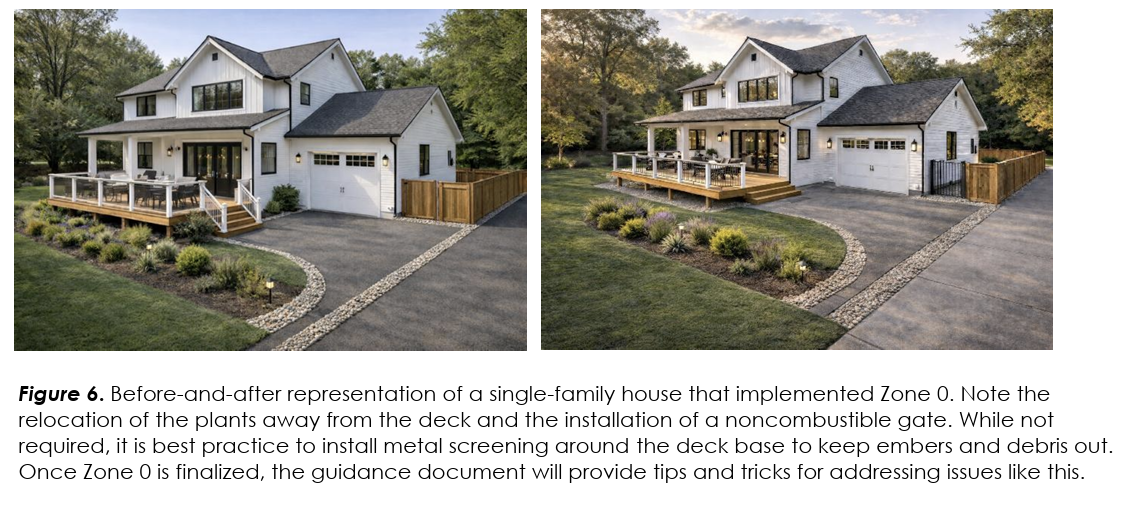
Credit: Board of Forestry and Fire Protection Draft Zone 0 Regulations / April 2026
Part 9: For Contractors, Designers, and Architects
A few things I'd want a colleague to know:
Know which rulebook you're in before you open your mouth on a jobsite. A homeowner asking "is my deck legal" is usually asking a defensible-space question while you're answering a building-code question, or vice versa. Say which one you're answering.
Design the fence transition as an element, not a patch. Five feet of noncombustible material is going to appear on thousands of properties in this corridor over the next few years. Most of it will be an off-the-shelf steel panel jammed against a wood fence. There's an enormous amount of room to do this better — masonry pilasters, steel-and-stone bases, detailed transitions that read as part of the design language of the house. Whoever solves this well is going to be busy.
Heavy timber is underused. A 4x-dimension compliance path opens up an aesthetic that most WUI-zone projects give up on entirely. It costs more in material and it changes your framing approach, but it's a listed method and it looks like something.
Verify products against the CAL FIRE Building Materials Listing, not the manufacturer's marketing. Every cycle produces a crop of "fire-rated" products that aren't listed for the use in question.
Watch the code cycle boundary. The 2025 Title 24 applies to permit applications submitted on or after January 1, 2026, with no grandfathering based on contract date. Local amendments often lag the state adoption by a few months, which creates a genuinely confusing window.
Get the first five feet into the drawing set on rebuilds. On new construction there's no phase-in. Landscape, fencing, and hardscape decisions that get deferred to "later" on an Altadena rebuild get made twice.
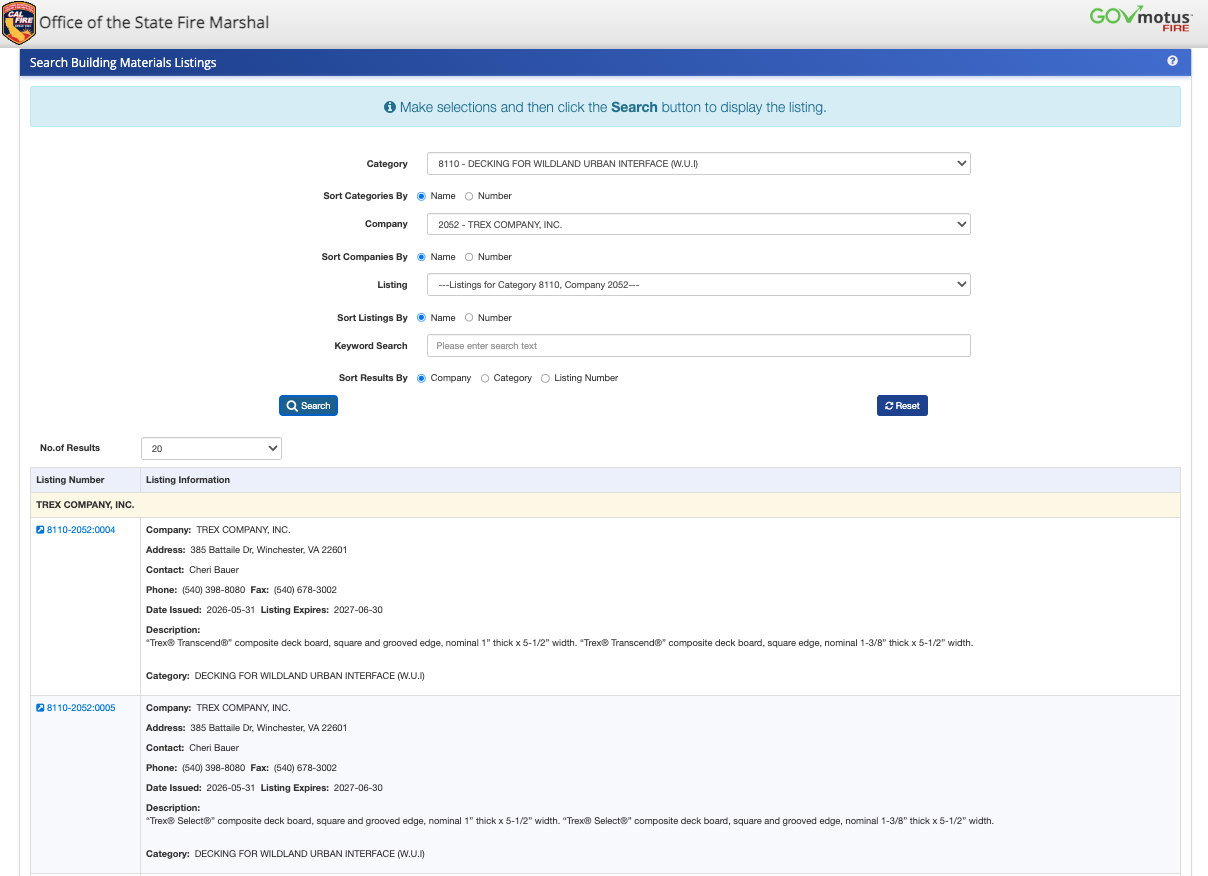
Screenshot of CAL Fire Building Materials Listings Search Portal
Part 10: Where Redwood Still Belongs
I build in Con Heart redwood, so let me be straight about what these rules do and don't do to my own material.
Within the first five feet, the rules constrain new combustible fencing and gates, and require Chapter 7A construction for outbuildings. They do not eliminate wood from the zone — an attached deck is part of the structure, and Chapter 7A's compliance paths include heavy timber and exterior fire-retardant-treated wood.
Beyond the five-foot line, in Zone 1 and Zone 2, wood fencing, gates, arbors, pergolas, and freestanding structures remain entirely permitted, subject to the ordinary maintenance requirements — keep it clear underneath, keep vegetation managed, keep it in good repair.
What actually changes is where the thinking has to happen. The five-foot line is now a real design boundary. Cross it well and the house looks intentional. Cross it badly and it looks like someone bolted a fire code to a nice yard.
I'd rather help people cross it well.
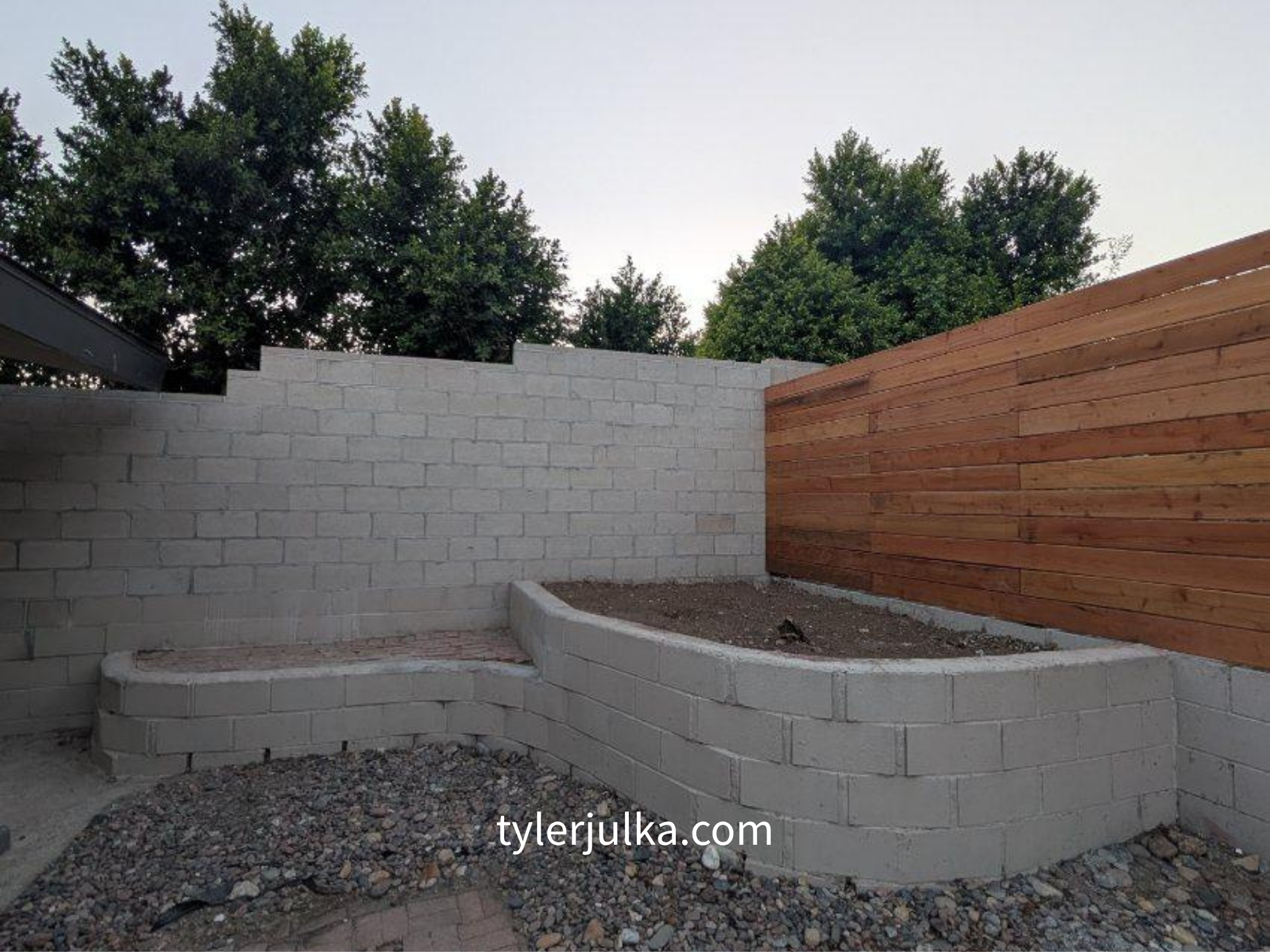
Redwood fence connection to CMU wall, block wall runs to the house, Altadena rebuild.
Verify This Yourself
I'm a licensed contractor, not a code official, a fire marshal, or an attorney. This guide reflects the rules as approved on August 19, 2026, before the Office of Administrative Law completes its review — details can shift before the final filing, and your local jurisdiction can be stricter than the state. Confirm anything you're about to spend money on with your local building department and fire agency.
Primary sources worth reading directly:
California Board of Forestry and Fire Protection — the Zone 0 rulemaking page, final rule text, and the illustrated summary sheet with example figures
CAL FIRE Office of the State Fire Marshal — Fire Hazard Severity Zone maps, to look up your own parcel
CAL FIRE Building Materials Listing — to verify whether a specific product is actually listed for the use you have in mind
California Building Code, Chapter 7A — Sections 704A (ignition-resistant material), 709A (decking), 710A (accessory buildings and miscellaneous structures)
Public Resources Code Section 4291 — the underlying defensible space statute
AB 3074 (2020), SB 504 (2024), AB 1455 (2025), Executive Order N-18-25 — the legislative chain behind Zone 0
Your local fire department — LAFD or LA County Fire in my service area. LAFD's brush clearance requirement runs 200 feet, beyond the state's 100.
Questions?
If you're in Sunland, Tujunga, La Crescenta, Shadow Hills, or Altadena and you're trying to figure out what any of this means for a specific structure on your specific property, I'm happy to answer questions — including the ones where the answer is "you don't need to do anything and you don't need to hire me."
Tyler Julka
T.J. Julka Construction, Inc. | CSLB #1104821
Custom redwood fences, gates, decks, arbors, pergolas, and patio covers